XinmoJet

TIJ ink cartridges · made in our own plant

TIJ ink cartridge manufacturer and factory

We make the cartridge and we make the ink. HP45-format bodies in 12.7 mm and 25.4 mm, 42 ml industrial fill, four ink systems, no chip lock-out. Send us your material and we print your code on it — free, before you order.

  • Open chip — no authorisation handshake, no single-use lock-out
  • 42 ml industrial fill, not a reduced service fill
  • Four ink systems: water-based, fast-dry solvent, covert UV, oil-based
  • Free printed samples on your own material
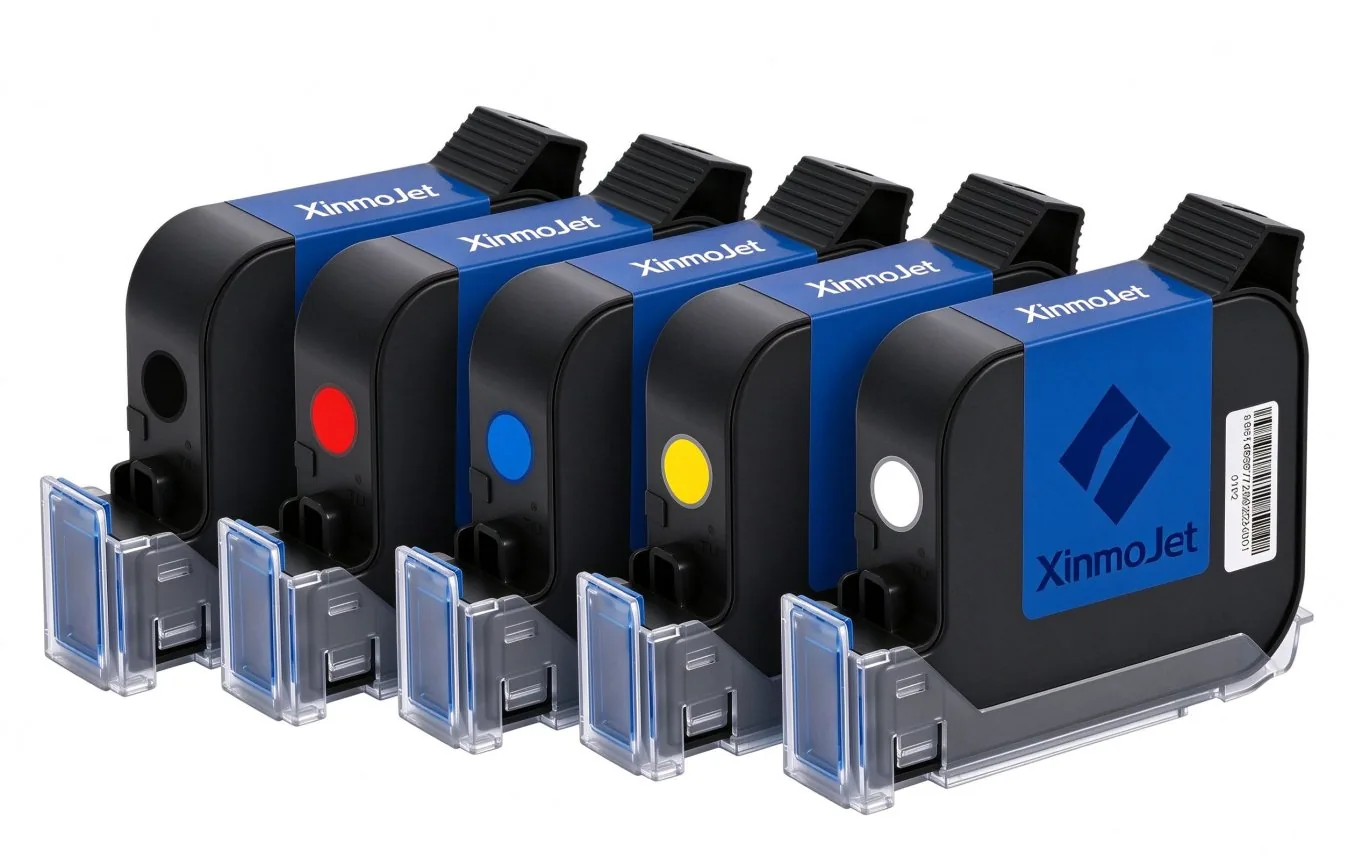
Five XinmoJet HP45-format TIJ ink cartridges in black and colour grades, standing in a row on a workshop bench
Open-system TIJ cartridges — factory direct — All dimensions and volumes are metric.

12.7 / 25.4

Print width · mm

42

Industrial fill · ml

4

Ink systems

160

Cartons · min. order

Four problems that decide whether a TIJ line pays for itself

These come up in almost every first conversation. Not one of them is fixed by a cheaper cartridge.

01

The cartridge is locked to one supplier

An OEM cartridge carries an encrypted chip. The printer refuses anything else, and refilling or third-party supply is blocked in firmware. You are not buying a cartridge. You are buying a supply agreement you cannot leave.

Ours are open-system: no chip lock-out, no authorisation handshake. Because we make them rather than resell them, that is a decision we control — not a promise about somebody else’s hardware. Run ours as a second source without replacing the printer.

02

Consumables quietly become the biggest cost

The printer is bought once. Cartridges are bought every month, and once the platform is locked the price is not yours to negotiate. Most buyers find out where the money sits around month twelve.

We quote per thousand marks against your actual coding content, so the comparison is your real output, not a list price. Fill is a full 42 ml, not a reduced service fill.

03

The ink stops drying when the material changes

A water-based ink that is perfect on carton will not bond to HDPE. Switch substrate — or your supplier changes the surface treatment — and codes start smearing on the roller, two stations downstream from the cause.

Ink follows substrate here, not the other way round. Send the material and we match the ink to its surface energy, then print and run the tape and wipe tests.

04

Nozzles drop out mid-shift

Missing nozzles leave white gaps through a date code. It gets blamed on the cartridge; often the real cause is the run pattern or a long idle stop.

We build the body and formulate the ink, so decap behaviour is ours to change. Our datasheets publish it per ink so you can plan stoppages, and a dropped nozzle means a new cartridge — not a cleaning routine.

Which cartridge suits my material?

Answer two questions — what you print on, and what the code has to survive. We narrow the ink system, the drying band and the printer configuration.

  • Material first, then ink: surface energy decides adhesion, not colour
  • Pretreatment flagged up front, not discovered at commissioning
  • You get the test method that settles the question

Substrate matching tool

Pick the material you print on and what the code has to survive. The recommendation updates immediately.

1 · What are you printing on?
2 · What does the code have to survive?

Confirm by sampling on your own substrate

Select a material to see a recommendation.

The numbers that decide whether a code survives

Most datasheets give a colour and a volume. These are the properties that actually decide whether a mark survives handling, condensation and solvent.

The numbers that decide whether a code survives
Ink system Code Viscosity Surface tension Primary substrates Drying band Rub / wipe resistance
Water-based (W) Water-based W 1–5 mPa·s 30–45 mN/m Corrugated carton, Kraft paper, Wood, Paperboard Under 1 s — absorbed into the fibre Withstands a tape test on porous stock; confirm on your product
Solvent fast-dry (S) Solvent fast-dry S 1.2–2.5 mPa·s ≈23 mN/m (static) HDPE, PP, PET, Coated metal, PVC, Glass Typically 1–5 s on non-porous surfaces Strong once fully cured — cure time, not dry-to-touch, is the limit
Covert UV (invisible) (U) Covert UV (invisible) U 1–5 mPa·s 30–35 mN/m Pharma cartons, Cosmetic packaging, Labels, Documents Carrier dependent, then verified under UV High after full cure — verify under UV on the actual substrate
Oil-based (O) Oil-based O 2–5 mPa·s — Flexible film, Foil, Specialty labels Typically 1–5 s, coating dependent To be confirmed against the ink datasheet

Viscosity and surface tension are published industry ranges for each ink class, not a substitute for the ink-specific datasheet. Drying bands depend on substrate, ink load and ambient conditions. Confirm every range against the datasheet for your chosen model — and against a sample.

How a project starts

One week on a sample beats finding out at commissioning that the ink will not hold.

  1. 01

    Tell us the conditions

    Material and surface state, line speed, what you print, and what the code has to survive. Dust, condensation, washdown — all of it matters.

  2. 02

    We shortlist an ink system

    A recommendation with the reasoning shown: ink class, print width, whether pretreatment is likely, and what we still cannot answer without a test.

  3. 03

    We print on your material

    Actual substrate, then tape, rub and wipe tests as applicable. You get the printed pieces and the results — not a claim.

  4. 04

    Fix the configuration and scale

    Once the sample passes, model, print width and printer configuration are settled. Reordering is then a part number, not a new project — off the same line that printed your sample.

What "open system" actually means

It describes how the cartridge and printer authenticate. It is not a marketing adjective.

NOZZLE PLATE 1/300 in pitch
Schematic: offset nozzle rows on a thermal inkjet printhead. Nozzles are fired in groups; the row offset compensates for the paper feed increment between passes.
12.7 mm Half-inch · 1 head 25.4 mm One-inch · 1 head 50.8 mm 2 × one-inch stitched 76.2 mm 4 × one-inch stitched
One cartridge prints a fixed band — 12.7 mm or 25.4 mm tall. For taller content you mount several heads side by side and stitch the output into one image. Two heads stacked give 50.8 mm, four give 76.2 mm.

No chip lock-out

No authentication handshake is needed for the printer to accept the cartridge. No single-use enforcement, no firmware gate.

Second source, not replacement

Qualify ours alongside your current supply. Most buyers run a trial line first, then move volume once the sample clears their own check.

Specifications published

Viscosity, surface tension, drying band, print width and capacity are listed per model. Where a value depends on the model, we say so.

Whole-cartridge replacement

Printhead, reservoir and filter are one assembly. A dropped nozzle is solved by changing the cartridge, not by booking a service visit.

What buyers ask before the first order

What does XinmoJet actually make in house?

The cartridge and the ink. We fill, seal and test every cartridge on our own lines and formulate the ink that goes into it. The printhead assembly is bought in from specialist printhead manufacturers and qualified by us, and the handheld and inline printers are supplied jointly with specialist equipment-manufacturing partners. We publish that split because a manufacturer that will not describe its own production steps usually is not one.

How do I tell a manufacturer from a trading company?

Ask what the company does itself. A trader describes products; a TIJ inkjet factory describes steps, equipment and inspection records. Five questions settle it, and our own answers — including where the honest answer is that we buy the part in — are on the factory page.

Do you supply the printers too?

Yes, but not as our own manufacture. Cartridges and ink are ours; the handheld and inline printers are supplied jointly with specialist equipment-manufacturing partners. We qualify the cartridge-and-printer combination so what reaches your line is a working system, not two boxes.

What is the smallest order?

One carton of 160 cartridges. Printed samples on your own material are free. Most buyers test the ink on their substrate first — send us the material you actually code on and we print on it.

Send us your material. We send back a printed code.

Tell us the material, the line speed and what you need to print. We will name the ink system and post you samples you can test yourself.