
Engineering
Coding on HDPE and PP: what decides whether the mark holds
Polyolefins are the awkward end of inkjet coding. HDPE measures roughly 28–32 mN/m untreated and PP about 26–28 — both below the surface tension of most coding inks, so a mark can look perfect wet and flake off under a thumb. Three things decide the outcome: the surface state of the part you actually run, the ink system matched to it, and where on the part the code sits. The printer matters far less than any of the three.
What gets coded onto plastic, and why the content decides where it can go
A moulded or extruded part is rarely a blank surface. It carries a gate mark, a weld line, a mould seam, a rib, a recessed panel or a label edge — and each of those is a place where a printed mark either sits comfortably or fights the surface.
Content falls into two families. The first is the traceability string that goes on every pack — date, best-before, batch — covered on our date and batch coding page. The second is specific to plastics: a part number, mould or cavity identifier, supplier code, GS1 DataMatrix, serialised string, or a QR code the end user is meant to scan.
The second family bites, because those codes are longer and denser than a date string. A two-dimensional symbol needs a flat, contrasty patch of a defined size, and on a small moulded part that patch may not exist yet. So the first question is not which ink — it is how many millimetres of usable flat surface the part offers, and at what angle.
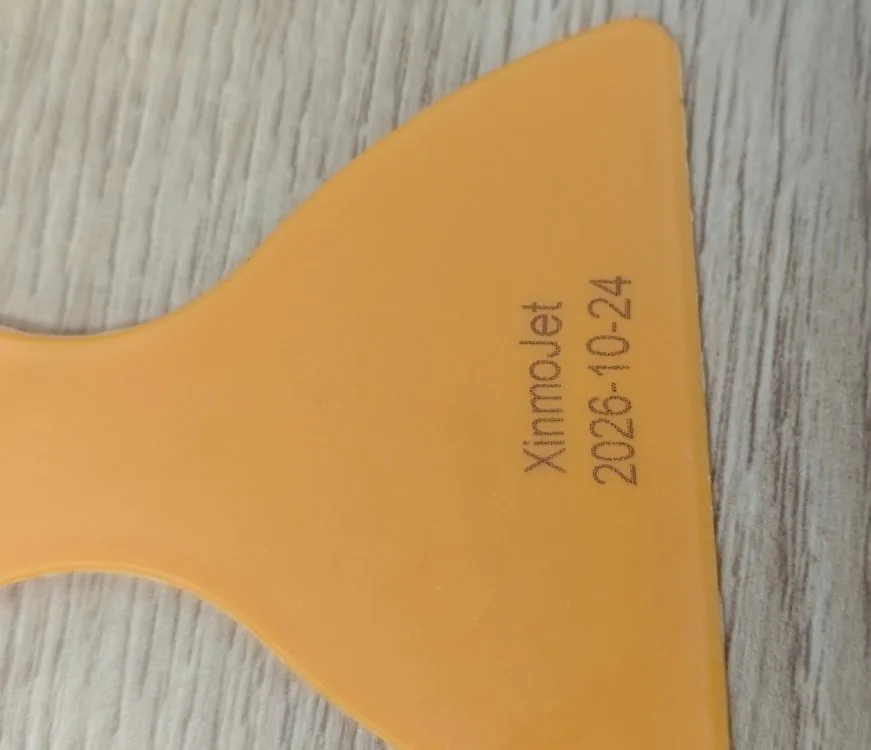
Why HDPE and PP are the hard ones, and why PET usually is not
Untreated polyolefins sit below the surface tension of a coding ink, so the drop does not wet — it rests on top and dries there. In the published ranges we work from, HDPE is about 28–32 mN/m and PP about 26–28 untreated, against PET at 40–42. That is why the same cartridge that holds on a PET bottle can fail on an HDPE jerrycan. The full surface-energy table, pretreatment options and drying bands are on our substrate matching guide.
Two things specific to plastic parts are worth checking first. Mould release agent: a part straight out of the tool can carry a silicone or wax film that a wiped lab coupon does not. And recycled content: a regrind or PCR grade can differ from virgin stock in both colour and surface state, so the sample has to be the grade you actually run.
Which ink system fits an HDPE or PP part
On a non-porous polyolefin a solvent system is the usual start. Nothing soaks into HDPE, so the carrier has to flash off — and water-based is the one most likely to lift from an untreated surface. On treated film, or a coated or lacquered part, the picture changes. That is one reason we ask for the part, not the material name.
Drying is a line-layout question more than an ink question. What matters is the distance from the head to the first roller, stacker or point where two printed surfaces touch, at your line speed. Where that distance is short, the answer is more often to move the head or add air than to change the cartridge.
For this case we supply a 42 ml cartridge in HP45 format, in 12.7 mm and 25.4 mm print widths, and we formulate the ink ourselves. Which of the two suits a part follows from the print width the part allows, not from preference.
How to qualify a mark on your own parts
A sample printed on a clean laboratory coupon tells you what the ink can do. It does not tell you what your part will do. These are the steps we ask customers to run, in this order, before a production run is committed.
- 01
Send the part, not a substitute: same polymer grade, same colour, same surface as it comes off your line — including the mould release, and not cleaned up for the trial.
- 02
Print the real content at the real line speed. A short date string is not a test of whether a dense code fits.
- 03
Rub it with a thumb, then with the solvent your cleaning routine uses, and look at contrast rather than at colour.
- 04
Put the part through the next steps of your own process — the leak tester, the capper, the label applicator, the shrink tunnel, the case packer — and re-check it afterwards, not before.
- 05
Keep a printed part at the temperature and humidity of your warehouse and look at it again in a few weeks. On plastic, some failures are slow.
- 06
Tell us early if the pack is food-contact or medical. The declaration sits with the party placing the product on the market, and it changes what the sampling brief has to cover.
Handheld or in-line — and what we actually supply
On plastic the choice is usually settled by the part rather than by volume. A handheld coder suits large moulded items, mixed work and anything that does not travel on a conveyor: the operator positions the head and triggers the print. It is the usual answer for crates, pails, drums and one-off marking.
An in-line unit takes its trigger from a photocell and its timing from an encoder, so the print position follows the product rather than the operator. On an extrusion or filling line — profile, pipe, cable jacket, a bottle coming off a filler — it is the only practical route, and it removes the human variable.
To be clear about what we supply: we make the cartridge and we formulate the ink. The handheld and in-line printers are supplied together with specialist equipment-manufacturing partners — we qualify and support the combination, so that cartridge, ink and machine settings work as one system, but the machine itself is not built in our plant.
What we need from you to quote a plastic application
A plastic enquiry can usually be answered properly the first time if the brief carries a few specifics. This is the list we ask for; anything you cannot answer yet, we can work out together from a part.
- 01
The part, or a length of the film, as it comes off the line — including surface treatment and mould release, if any.
- 02
The polymer, and whether the stock is virgin, regrind or a PCR grade.
- 03
The line speed, and the distance between the printhead position and the first thing that touches the print.
- 04
The code content, the number of lines, and the height each line has to be.
- 05
The monthly volume, and the destination market if the pack carries a regulated mark.
Standards and references
Where a figure or a method on this page rests on an outside standard, the standard is named here and linked to the publisher. We do not paraphrase what a standard says — the document itself is the authority.
- ASTM D2578 ASTM International
A wetting-tension (dyne) test method for polyethylene and polypropylene film. It measures the state of a treated surface; it does not by itself predict how an ink will hold.
- EU Regulation No 10/2011 European Union
The European framework for plastic materials and articles intended to come into contact with food. It decides what a sampling brief has to cover when the pack is food-contact.
ISO and ASTM documents are sold by the bodies that publish them; the links open each publisher’s own page, where the abstract and scope are public.
Questions that come with a plastic coding enquiry
Can one cartridge code both a bottle and its cap?
Not necessarily with the same result. The cap is usually a different polymer grade from the body, the shrink sleeve is a different polymer again, and each has its own surface state. The cartridge and the ink can be the same; what changes is whether the mark holds. Send both parts and we will print on both before you commit.
Can you print on a curved surface or a small moulded part?
Sometimes, and the limit is the flat band the part offers rather than the size of the part itself. A printhead held at a fixed height loses focus as the surface curves away, so the usable arc is narrower than the part looks. Send the part with the position marked where the code has to go, and we will say what fits at that distance.
Will the mark survive a water bath, a leak test or a solvent wipe?
That has to be tested rather than assumed. A leak test, a condensation cycle or a cleaning wipe with ethanol or IPA all put liquid onto the mark, and ink that was dry in the warehouse can lose contrast when the surface is wet. The wipe test, with the solvent and the dwell time you actually use, is what settles it.
Do you supply the printer, or only the cartridge and ink?
The cartridge and the ink are ours. The handheld and in-line printers are supplied together with specialist equipment-manufacturing partners, and we qualify the combination so that cartridge, ink and machine settings work as one system. Tell us the part, the content and the line speed and we will specify the combination.
Send us your material. We send back a printed code.
Tell us the material, the line speed and what you need to print. We will name the ink system and post you samples you can test yourself.