
Cartridges
Invisible UV Security Ink Cartridge — Covert Marking for Anti-Counterfeiting
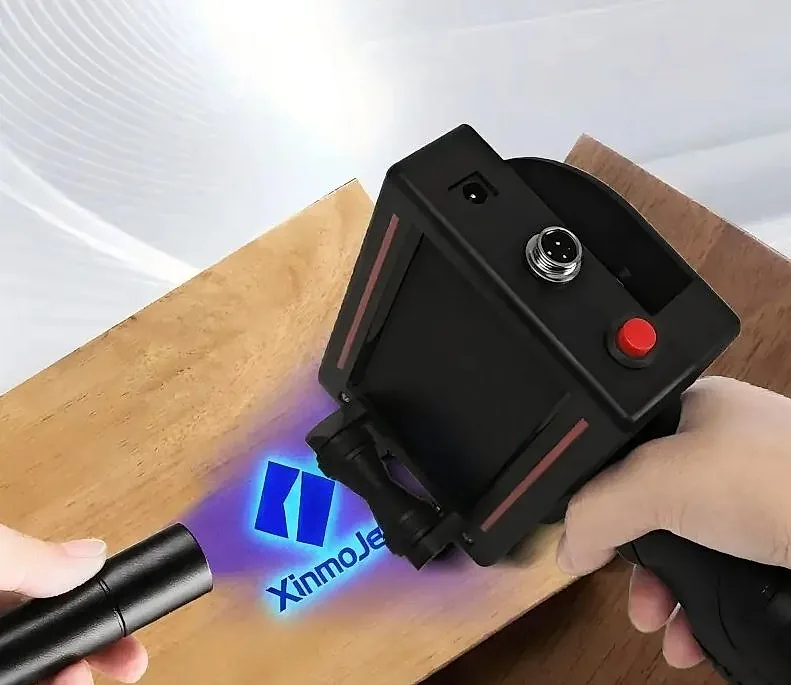
A covert TIJ cartridge that prints a mark invisible in daylight and readable under a 365 nm UV lamp, for traceability, warranty control and anti-counterfeiting. If the check you already run uses a UV lamp, this is the cartridge that fits that step.
Key specifications
- Model
- XM-45U
- Print width
- 12.7 mm (half-inch, XM-45U-127) and 25.4 mm (one-inch, XM-45U-254)
- Ink base
- Covert UV (invisible)
- Capacity
- 42ml
- Resolution
- Native 300 dpi, up to 600 dpi depending on print mode
- Chip
- Non-encrypted / open chip — no authentication handshake, no single-use lock-out
Published unit price
USD60
MOQ160
- EXW — factory price, freight and duty not included
- 30-day full refund if the goods do not match what this page describes
Overview
A covert mark is one the customer cannot see. The pack looks identical to a copy — until someone puts it under a UV lamp. That makes this cartridge useful in three situations: proving a returned item is genuine, tracing which production batch or market a unit came from, and putting a verification step into a supply chain without changing how the pack looks.
The ink is the same HP45-format thermal inkjet platform as our standard cartridges, with a fluorescent chemistry in place of a visible pigment. The mark is applied exactly like any other code: same cartridge seat, same printer, same file. What changes is verification — it needs a 365 nm UV source rather than a camera.
One caveat decides whether a covert mark is the right tool, and it is not about the ink. Many papers, cartons and coatings fluoresce under UV on their own. If the substrate glows brighter than the mark, the mark is unreadable and no cartridge will fix it. Send us the packaging board before you commit, and we will tell you whether the contrast is there.
Design points
Invisible in daylight, readable under UV
Fluorescent chemistry rather than a visible pigment. The pack design is unchanged, which is what makes the mark useful for authentication and for market-specific traceability.
Fluorescent red, green and blue/violet
Three fluorescence colours are available. Where a customer already uses one colour for an existing brand mark, another gives you a separate covert layer on the same pack.
Verify substrate fluorescence first
Coated boards that glow under UV will mask the mark. Test the board before choosing the ink colour, not after — this is the single most common reason a covert project fails.
Same platform as the visible cartridges
Identical HP45-format body, seat and driver requirements. No separate printer, no separate service training, no second spare-parts list.
Open chip, no lock-out
Same non-encrypted design as the rest of the range. No authentication handshake, no single-use enforcement, and no firmware gate on a genuine cartridge.
Supports variable data
Serial numbers, batch identifiers and market codes can be printed as variable data, so each unit carries a unique covert identifier rather than one shared mark.
Print height: half-inch against one-inch
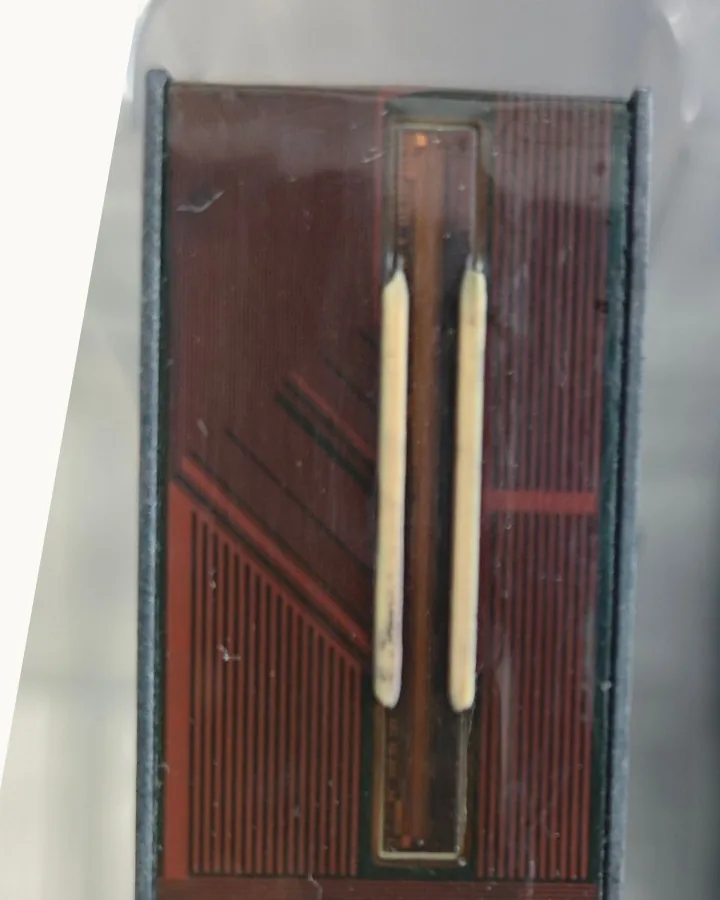
The same cartridge quoted in two print widths, drawn below at the same scale. It is the dimension the spec table calls print width: as the head travels across the product, that width becomes the height of the band it leaves.
Full technical data
| Model | XM-45U |
|---|---|
| Print width | 12.7 mm (half-inch, XM-45U-127) and 25.4 mm (one-inch, XM-45U-254) |
| Ink base | Covert UV (invisible) |
| Capacity | 42ml |
| Drying time | Carrier dependent, typically 1–5 s, then verified under a 365 nm UV source |
| Resolution | Native 300 dpi, up to 600 dpi depending on print mode |
| Chip | Non-encrypted / open chip — no authentication handshake, no single-use lock-out |
| Primary substrates | Coated and uncoated carton, Paper and label stock, Pharmaceutical secondary packaging, Cosmetic secondary packaging, Certificate and document stock, Selected film and foil surfaces |
| Colours | Colourless in daylight, Fluorescent red under UV, Fluorescent green under UV, Fluorescent blue/violet under UV |
| Storage | Store sealed, out of direct light and away from UV sources, at room temperature. Do not leave the nozzle plate exposed to air; fit the original cap when the cartridge is out of the printer. |
| Platform | HP45-format thermal inkjet (TIJ 2.5), one-piece cartridge |
| Excitation | 365 nm UV (long-wave); a 365 nm lamp with a visible-light filter is recommended |
| Fluorescence colour | Red, green or blue/violet under UV, selected at order |
| Daylight appearance | Colourless; a slight sheen may be visible at a low viewing angle on glossy stock |
| Carrier substrate | Selected first; the covert layer is applied over the carrier, not instead of it |
The numbers that decide whether a code survives
| Ink base | Covert UV (invisible) |
|---|---|
| Viscosity | 1–5 mPa·s |
| Surface tension | 30–35 mN/m |
| Drying time | Carrier dependent, then verified under UV |
| Rub / wipe resistance | High after full cure — verify under UV on the actual substrate |
| Primary substrates | Pharma cartons, Cosmetic packaging, Labels, Documents |
Viscosity and surface tension are published industry ranges for each ink class, not a substitute for the ink-specific datasheet. Drying bands depend on substrate, ink load and ambient conditions. Confirm every range against the datasheet for your chosen model — and against a sample.
Typical applications
- Authentication marks on pharmaceutical secondary packaging
- Cosmetic and personal-care pack verification
- Premium beverage packaging and tamper evidence
- Spare-part and warranty labels for grey-market detection
- Certificate, ticket and document verification
- Batch and market traceability without altering pack artwork
Engineering notes
- 01
Always confirm the substrate first. A covert mark is only as good as the contrast between the mark and the background fluorescence of the board. Test before specifying a colour.
- 02
State the verification equipment at the outset — handheld lamp, fixed inspection station or inline vision system. The excitation and filter requirements differ, and the reading can be checked far more reliably when the reading method is known in advance.
- 03
A covert mark is not a public deterrent. It proves authenticity to someone who is looking for it; it does not stop a counterfeiter who never checks. Most programmes pair a covert mark with a visible security feature, and the two serve different purposes.
- 04
Where the packaging is food-contact, the applicable migration requirements for the destination market are set by that market's regulator. Confirm the requirement with your customer or laboratory; we supply the ink technical data for that assessment rather than certifying it.
Where a covert mark earns its place
A visible security feature tells a counterfeiter what to copy. A covert mark does not, which is why the two are usually deployed together rather than as alternatives. The visible feature deters; the covert mark proves.
Three programme types benefit most:
Authentication. A returned or seized item can be checked against a genuine reference under a lamp, in seconds. This matters where the item itself carries no serial number, or where the packaging is what gets copied.
Traceability without redesign. A batch identifier or market code can be added to existing artwork without changing the print run. The pack a customer sees is unaltered, so no artwork approval cycle is triggered and no competitor can read your market allocation off the shelf.
Warranty and grey-market control. A covert identifier ties a unit to a distribution channel. The unit that should not be in that market is detectable at inspection without any visible change to the product.
The failure mode to plan around
The recurring reason covert projects fail is not the ink — it is the background. Bleached and coated boards frequently contain optical brightening agents that fluoresce blue-white under UV (365 nm). If the board glows, the identification of the mark against it becomes a contrast question, and a low-contrast mark is a mark that field staff cannot read reliably.
There is a second, subtler version of the same problem: a mark that reads well on a bench under a powerful lab lamp may be unreadable under the low-power handheld lamp actually used at a returns desk. Verification conditions belong in the specification, not in the afterthought.
What is worth testing, and in what order
- Board fluorescence — put the unprinted packaging under the intended verification lamp and photograph it. If the board glows, the project needs either a different board or a different recognition method, and this is cheapest to discover first.
- Colour selection — test the candidate colours on the actual board. Choose the one with the better contrast against that specific background, not the one that photographs better on white.
- Reading under field conditions — re-check with the actual handheld lamp, at the actual working distance, with the packaging at the angle it will be presented. Not with a lab unit at optimal distance.
- Handling and abrasion — the covert layer sits on the surface, so it is exposed to the same handling as a visible code. Confirm it survives the real journey before release.
We will run steps one through four on your packaging board and send back the printed pieces with the results. A covert programme that has not been through these four steps is a specification, not a verified process.
Questions engineers ask
Can anyone see the mark?
Not under normal light. Under the UV source, though, a covert mark is visible to anyone who points a lamp at the pack — including the counterfeiter, once they know it exists. Treat a covert mark as a verification and traceability tool rather than as a secret, and assume that any feature you deploy will eventually be known about.
My board glows under the UV lamp. Is there anything I can do?
This is the most common reason covert projects fail. If the board itself fluoresces, the contrast between the mark and the background is reduced. Options are to select the fluorescence colour that contrasts best against that specific background, to move the mark to a smaller area of the pack with lower background fluorescence, or to change the board. Send us the board and we will tell you which of these applies before you commit to ink.
What lamp do I need to verify it?
A 365 nm long-wave UV source with a visible-light filter. Please specify the verification equipment when you enquire — a handheld inspection lamp, a fixed inspection station and an inline vision system have different excitation and filtering requirements, and the reading is much more reliable when the reading method is known at the specification stage.
Can the ink be used on food-contact packaging?
The applicable migration limits and test methods are set by the regulator of the destination market, not by the ink supplier. We provide the ink technical data and safety documentation that your customer or laboratory needs for that assessment, and we do not issue the conclusion ourselves. Confirm the requirement with your customer before sampling.
Can I run it in the same printer as a visible ink?
Yes, the body, seat and driver requirements are identical to our standard cartridges. Note that you cannot mix formulations inside one cartridge, and switching between a visible and a covert ink on the same printer normally means changing to a dedicated cartridge rather than topping up.
Is it available in both print widths?
Yes — 12.7 mm and 25.4 mm. For a serial number or a compact batch code the half-inch is usually sufficient; a data block that combines a covert code with a visible date line is easier to lay out at 25.4 mm.
Send us your material. We send back a printed code.
Tell us the material, the line speed and what you need to print. We will name the ink system and post you samples you can test yourself.