
Technical Notes
Choosing Between 12.7 mm and 25.4 mm TIJ Cartridges
Print width is the constraint that decides what content is physically possible, and it is usually settled far too late in a project. Here is how to work backwards from the code you need to the width you must buy, including the QR code trap that catches most first-time buyers.
The two standard TIJ widths — 12.7 mm (half-inch) and 25.4 mm (one-inch) — are not a small and a large version of the same thing. Each sets a hard ceiling on how much content fits in a single pass, and nothing in the controller gets around it.
It is also the decision most often made too late. Buy a handheld with a half-inch carriage and the only way past that ceiling is a second printer.
So answer the width question before anything else, including the ink system.
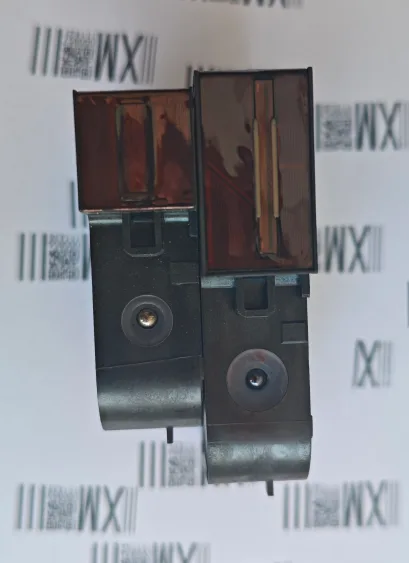
Working backwards from the code
The right starting point is not the width. It is the code content, measured in lines and character heights.
| What you need to print | Half-inch (12.7 mm) | One-inch (25.4 mm) |
|---|---|---|
| One line, date or batch code | Comfortable | Comfortable |
| Two lines of small text | Possible at reduced height | Comfortable |
| Three lines | Not realistically | Workable |
| QR or Data Matrix alone | Comfortable, if module size allows | Comfortable |
| QR plus a date line | Too tight — see below | The practical choice |
| Logo or graphic element | Usually not | Possible |
The pattern is that a half-inch body handles a single-line code very well and starts to struggle the moment a second element is added. It is a fine choice for date and batch coding. It is the wrong choice the moment the code has to be machine-readable and human-readable at the same time.
The QR code trap
This is the mistake that costs people money most often. A buyer specifies a half-inch handheld unit because the current code is a simple date stamp. Then traceability requirements arrive, and the code has to carry a QR symbol as well.
Fitting a QR code into 12.7 mm forces the module size down. At a typical industrial print height, a QR symbol with enough data to be useful will end up with modules below the size a moving-line scanner can resolve reliably. The result reads fine on a bench test and fails on the line — usually as an intermittent scan failure that gets blamed on the scanner.
The arithmetic is straightforward and worth doing before purchase. A QR symbol needs a quiet zone on each side, and the module count is set by the data payload and error-correction level, not by your preference. Divide the available width by the module count and compare the answer against your scanner’s minimum. If the number is marginal on a half-inch body, the one-inch body is not an upsell — it is the difference between a code that scans and one that does not.
One more point belongs in the acceptance criteria rather than in the bench test. ISO/IEC 15415 defines how two-dimensional symbols are measured and graded, so “my scanner read it” is not the same evidence as a grading result at the level a customer asks for. If a verification requirement exists, apply it to the sample that comes off your line, not to the code on your desk.
Where print width interacts with ink
Width and ink are not independent. A wider print window means more ink deposited per mark, which changes the drying budget. On a fast-dry solvent system the difference is usually absorbed without complaint. On a water-based ink going into absorbent carton, a larger block of text can take longer to dry than the line allows, and the fix is layout rather than cartridge.
This is the point at which it is worth checking the substrate and ink relationship before committing to a width — the two decisions are usually made together, and making them in the wrong order is how projects end up with a printer that cannot do the job it was bought for.
Handheld versus inline changes the answer
On a handheld unit, the width has a physical cost: a one-inch body is heavier and changes the balance of the device, which matters over a full shift. Operators notice this, and a printer that is tiring to hold gets used less carefully.
On an inline installation, weight is irrelevant and the width is essentially free — so the one-inch body is the safer default, and multi-head stitching can extend the print window further without changing cartridges. If you are choosing for a fixed installation, buy width. If you are choosing for handheld work, buy only the width you can justify, because the ergonomic cost is real.
A wider cartridge is not a drop-in replacement
The most expensive assumption in this question is that a one-inch body can simply be fitted to a printer that currently runs half-inch cartridges. Whether it can depends on the machine rather than on the cartridge: the mechanical arrangement of the carriage, the electrical interface, and whether the controller’s software and layout settings support the second format. None of that is visible from the cartridge itself, and none of it follows from the two formats sitting in the same product family.
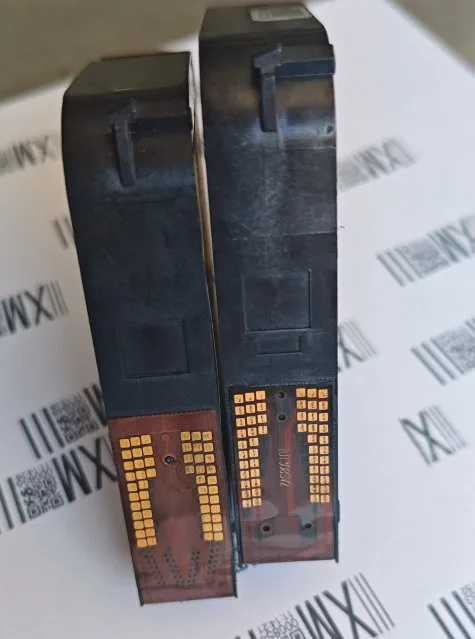
So do not read a supplier’s silence as confirmation. Ask for a verified compatibility record for the specific printer model and firmware, and keep “it fits” and “it prints correctly” as two separate tests. The same caution applies to the other convenient assumption — that the larger nominal dimension means sharper small text, or twice as much usable information. It means neither. What is actually stocked is listed on the cartridge range, and which bodies each machine accepts is listed on the printer range.
A short decision procedure
- Write down the exact code content, including anything expected to be added within two years.
- Convert the machine-readable part into a module size in millimetres and compare against the scanner’s minimum.
- Add the human-readable lines and check the total against the two widths.
- Only then choose the ink system, based on substrate and drying budget.
- Confirm the carriage accepts the width you chose — many compact handheld units take the half-inch body only.
Step five catches people more often than the others. The printer range lists which bodies each unit accepts, and if you send us the code content we will do the module-size arithmetic against your scanner specification rather than leaving you to guess.
Questions we get asked about print width
Can I fit a 25.4 mm cartridge in a printer that runs 12.7 mm cartridges?
Only if that machine is set up for it. Check the carriage, the electrical interface and the controller’s software support, and ask for a compatibility record for your exact printer model and firmware version. A cartridge that physically enters the slot has not yet been shown to print correctly.
Does the wider cartridge print small text more sharply?
No. Width is how much vertical room you have, not how fine the droplets are. Sharpness depends on the printhead’s native resolution and on the print mode you run, both of which are separate from the nominal format — so compare the same artwork at the same character height in the two trials rather than assuming the larger number wins.
Can one ink cover several packaging materials?
Test each surface separately, even when two packs carry the same material description, because coatings and surface treatments differ between suppliers and batches. The substrate and ink relationship sets out what to check, and a finished pack is the only sample that settles it.
What to send for a print trial
A width question is normally settled by one printed sample rather than by another specification. Send these six items and the answer comes back as a measured print:
- Printer brand and model, plus the cartridge reference you run today.
- The exact text, barcode or graphic you need to print.
- Target printed height, and the print area actually free on the pack.
- A photograph or a physical sample of the packaging material.
- Ink colour, and any rub, wipe or chemical resistance requirement.
- Line speed, printhead position, and what happens to the pack immediately after coding.
Send them to XinmoJet together. The result is a printed mark you can measure, handle and scan — which settles the width question before cartridges are committed to the line.
With the width settled, the solvent TIJ 2.5 cartridge covers both the 12.7 mm and 25.4 mm bodies, and see how our TIJ ink cartridge factory is run sets out who makes which part of the chain.
Related reading
- 30 October 2026
How Solvent TIJ Cartridges Are Made: Inside a Manufacturer's Line
A solvent TIJ cartridge is not bought parts relabelled. It is ink formulated and filtered, a body prepared and…
- 29 October 2026
How Much Does a Solvent TIJ Cartridge Really Cost? Cost per 1,000 Prints
USD 28–58 buys a solvent TIJ cartridge, and that number decides nothing. What reaches your margin is the cost …
- 28 October 2026
HP 2580 vs 2590 vs XM-45S: Which Solvent TIJ Cartridge Fits Your Line?
The number on the label decides three separate things — ink behaviour, chip and print height — and they do not…
Want this confirmed on your own material?
We print on samples of your actual substrate and send them to you. Send the material, the line speed and the code content, and we will tell you honestly whether the fault is the ink, the surface or the line layout.