
Technical Notes
Who Are the Top TIJ Printer Manufacturers in China?
A search for the top TIJ printer manufacturers in China returns company names and very little else, because the phrase covers at least four different kinds of business. Here is how they differ, what the word manufacturer means once the printhead itself is bought in, and why the supplier writing this manufactures TIJ ink cartridges rather than printers.
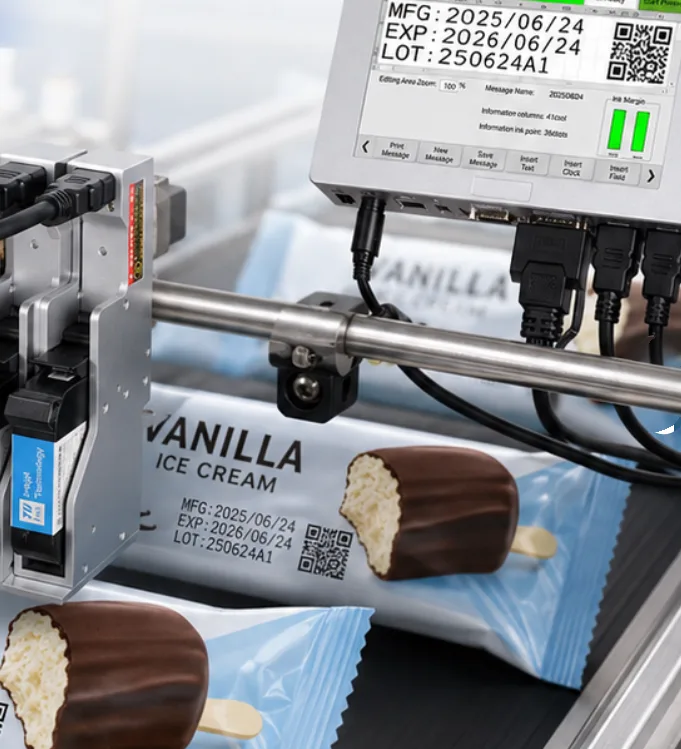
Searching for the top TIJ printer manufacturers in China produces a long list of company names and almost no way to tell them apart. Every website says manufacturer. Every catalogue shows a handheld coder above a row of half-inch cartridges. Very few pages say which parts of that product the company in front of you actually makes.
That gap matters, because the phrase covers at least four different kinds of business. The one you pick changes what you are allowed to ask for, how quickly a problem gets solved, and who carries the loss when a code fails halfway through a shift. There is no public ranking of Chinese TIJ suppliers that is worth organising a purchase around. There is a better question, and it has a short answer: find out what the supplier manufactures, and what it buys.
One correction before the detail, because the phrase itself invites the mistake. XinmoJet is a manufacturer of TIJ printer cartridges, and we formulate the ink that goes into them. We do not manufacture the printers. The whole article below is, in effect, the explanation of that one sentence: the cartridge and the machine are separate businesses, and knowing which side a supplier is on is what decides whether your questions get answered.
The question behind the search
What a supplier manufactures is more useful than how large it claims to be.
Thermal inkjet cartridges are not a product where the machine and the consumable can be judged separately. In this format the printhead sits inside the cartridge, so every cartridge change also changes the ejecting surface that does the printing. A buyer who is comparing suppliers is therefore comparing two decisions at once: the quality of the hardware, and the quality of the ink that has to survive on the substrate.
That is also why “top manufacturer” lists rarely help. A large supplier can be excellent at volume and uninterested in a one-carton trial on an unusual film. A small supplier can be the only one willing to adjust a formulation for one customer’s coated pouch, and still not be able to ship a full container next week. Neither is a ranking problem. Both are fit problems, and fit is decided by who owns which step.
Four kinds of supplier behind the same keyword
The same search term returns four businesses with completely different capabilities, and many Chinese suppliers combine two or three of them.
The platform side. The printhead at the centre of this category was designed by a large printer platform manufacturer, not by the companies selling cartridges under their own name. Cartridge makers in China buy that printhead as a component. This role is the furthest from most buyers: you do not choose it, and it does not answer your emails.
The cartridge maker. This is the operation that buys the printhead, builds the housing, formulates the ink, fills, seals, codes and tests. It is the layer that decides what actually happens on your line, because print quality is a function of printhead condition plus ink behaviour plus fill discipline.
The equipment assembler. Handheld and in-line coders are assembled and configured somewhere. Some suppliers own this step, some outsource it, and some have no connection to it at all.
The trading desk. A company with a website, a price list and no plant. It is not automatically a bad supplier, because a good trading desk can solve logistics efficiently. It becomes a problem when it answers technical questions it has no way to verify, such as whether a specific ink will hold on your material.
The honest version of any supplier’s home page would name all four steps and say which ones it owns. Very few do. Ours is on what we manufacture and what we buy, including the step we do not own.
What manufacturer means when the printhead is bought in
Buying the printhead does not disqualify a supplier, hiding the fact does.
A fair criticism of this category is that the word manufacturer is applied to operations that assemble rather than make. That criticism is correct, and the fix is precision rather than silence.
There is manufacturing left in a cartridge even when the printhead arrives as a purchased component: the housing and its tolerances, the ink chemistry, the fill volume and pressure, the seal, the chip behaviour, and the qualification that decides whether a batch ships. Calling none of that manufacturing would be wrong. Calling all of it manufacturing a printer would also be wrong.
That split is our own position, and it is deliberately unflattering compared with a page that implies a company builds everything. It is also the version we can defend when a purchasing team visits: see what we manufacture and what we buy.
Where a new entrant can be different
A supplier without decades of volume cannot win on scale, so it has to win on decisions.
Being new removes one option and opens others. XinmoJet was founded in August 2026; the people in it came from TIJ cartridge work at other companies, with more than ten years each before joining — experience inside the team, not a long company history.
What a new entrant cannot offer is a thirty-year supplier file or a price built on enormous volume. What it can offer is attention at the step that actually costs buyers money:
- Cartridges and ink are made in house. Four filling lines, a capacity of around 2,000 cartridges a day, and full inspection of what ships.
- The system is open. No chip lock-out and no authorisation handshake, so a cartridge can sit beside your existing supply instead of replacing it.
- Small orders are accepted on purpose. The minimum is 160 cartridges, and print sampling on your own material is free of charge. A trial you can run yourself is worth more than a specification sheet.
- Published prices. Black cartridges are listed at USD 28 for the half-inch (12.7 mm) format and USD 58 for the one-inch (25.4 mm) format, rather than being quoted only after a call.
- Ink work is in scope. Private-label cartridge labels and adjusted formulations are available, which is a different service from shipping a standard box with your logo added. The details are on OEM and ODM work.
None of that makes us the biggest, and we are not going to write that we are. It makes us specific: we compete on the cartridge and the ink, we say plainly that we are not a printer manufacturer, and the machine is supplied by a partner. If your requirement is a machine with a locked consumable and twenty years of brand history, we are not the right supplier, and it is cheaper for both sides to establish that early. Where we can genuinely help sets out the same boundary from our side.
How to compare two suppliers in one afternoon
Six questions, asked in the same order, sort a factory from a forwarding address.
Send these to every supplier on your shortlist, including us, and compare the shape of the answers rather than the tone.
- What do you make, and what do you buy? A supplier that will not separate the two is telling you something already.
- Which printhead goes into the cartridge, and is it new or previously used? This single question decides most of the price difference between two quotations, and it cannot be answered by looking at the cartridge. We set out the comparison in genuine versus rebuilt cartridges.
- Who formulates the ink, and can it be adjusted for my substrate? An ink quoted without the substrate is an incomplete quote, because adhesion, drying and code durability all move with the surface.
- What batch records travel with the shipment? Fill date and batch identification should exist before you ask for them.
- What is the minimum, what does sampling cost, and when does it ship? Our own answers are 160 cartridges, free on your material, and within three working days of payment — but the point is that every supplier should have a number.
- Who declares the machine, and under which customs code? The cartridge and the printer are separate import lines. We publish the code we use on our own documents and hand the equipment question to whoever supplies the machine; the reasoning is on customs codes, prices and minimums.
Seven more questions worth asking about a specific quotation are collected in why TIJ cartridge prices vary. The short version is that two quotations can only be compared once both describe the same printhead history and the same ink.
Answers that should make you slow down
The risky answers are the confident ones, not the vague ones.
A supplier is not necessarily bad because it gives an incomplete answer. It is worth pausing when an answer cannot be checked at all:
- An ink described as suitable for every material. Adhesion depends on the surface energy of your substrate, and on whether it is treated. Water-based, solvent and specialty systems behave differently, and a formulation that works on corrugated board may bead on an untreated polyolefin. Confirming suitability normally requires a sample printed on your own material.
- Forward-looking assurances without a mechanism. “It will be fine” is not evidence, and neither is a guarantee of compatibility with a machine the supplier has never seen.
- A printhead description that changes when you ask twice, or a refusal to state whether the cartridge is a first fill or a refill.
- No minimum, no lead time and no batch record, because there is no plan behind the price.
None of these are about size. A one-line workshop can answer all four questions properly, and a large trading company can fail all four.
Questions buyers ask about Chinese TIJ suppliers
Are Chinese TIJ cartridges as good as the original brand? The useful comparison is not national but component-level. Printhead provenance, ink formulation and fill discipline decide the result far more than the country of the factory. Ask what the printhead is, ask who formulates the ink, and print on your own material before you commit to a container.
Can I visit or audit the plant? Ask for it, and ask what you will be shown. A filling line, a batch record system and an inspection step are all observable. If a supplier cannot describe its own process in specific terms, a visit will not fix that.
Do you also supply the printing machine? Some Chinese suppliers do, some supply machines from partners, and some only supply consumables. Ours is the second case: the printing units are supplied with specialist equipment-manufacturing partners, while the cartridge and the ink are ours. We are a cartridge manufacturer, not a printer manufacturer. Machines carry their own terms, so they are quoted separately.
What is the minimum order? It varies widely, and it is one of the clearest signals of who you are talking to. Our own minimum is 160 cartridges, chosen so that a buyer can qualify a batch on their own line before scaling up. The cartridge range covers the half-inch, one-inch and multi-colour formats.
A short answer to the original question
The top TIJ printer manufacturers in China are not a fixed list, and the companies that rank highest in a search engine are not necessarily the ones that manufacture the most. The category is a supply chain: a printhead platform, cartridge makers, equipment assemblers, and sellers. The shortlist worth building is the set of suppliers that will describe which of those steps they own, in writing, before you ask twice.
XinmoJet is one of the new entrants in that chain, and we are deliberately specific about our place in it: we are a TIJ ink cartridge manufacturer. We make the cartridge and formulate the ink, we qualify the printhead, we do not manufacture the printers, and the machines are supplied together with specialist equipment-manufacturing partners. If that division of labour matches how you buy, the next step is inexpensive: send us the substrate you actually code on and the content you actually print, and we will print it and post it back.
If the cartridge is the part you are buying from us, date and batch coding on your line and coding on HDPE and PP cover the two applications we are asked about most, both running on our own 42 ml units.
That comparison covers the machine side. For the cartridge side of the same question — what a cartridge manufacturer actually owns, and the seven questions that separate a factory from a trading desk — see how to evaluate a TIJ cartridge manufacturer.
Related reading
- 30 October 2026
How Solvent TIJ Cartridges Are Made: Inside a Manufacturer's Line
A solvent TIJ cartridge is not bought parts relabelled. It is ink formulated and filtered, a body prepared and…
- 29 October 2026
How Much Does a Solvent TIJ Cartridge Really Cost? Cost per 1,000 Prints
USD 28–58 buys a solvent TIJ cartridge, and that number decides nothing. What reaches your margin is the cost …
- 28 October 2026
HP 2580 vs 2590 vs XM-45S: Which Solvent TIJ Cartridge Fits Your Line?
The number on the label decides three separate things — ink behaviour, chip and print height — and they do not…
Want this confirmed on your own material?
We print on samples of your actual substrate and send them to you. Send the material, the line speed and the code content, and we will tell you honestly whether the fault is the ink, the surface or the line layout.